
Beyond the Test Case: How a Quality-First Mindset Accelerates Product Management

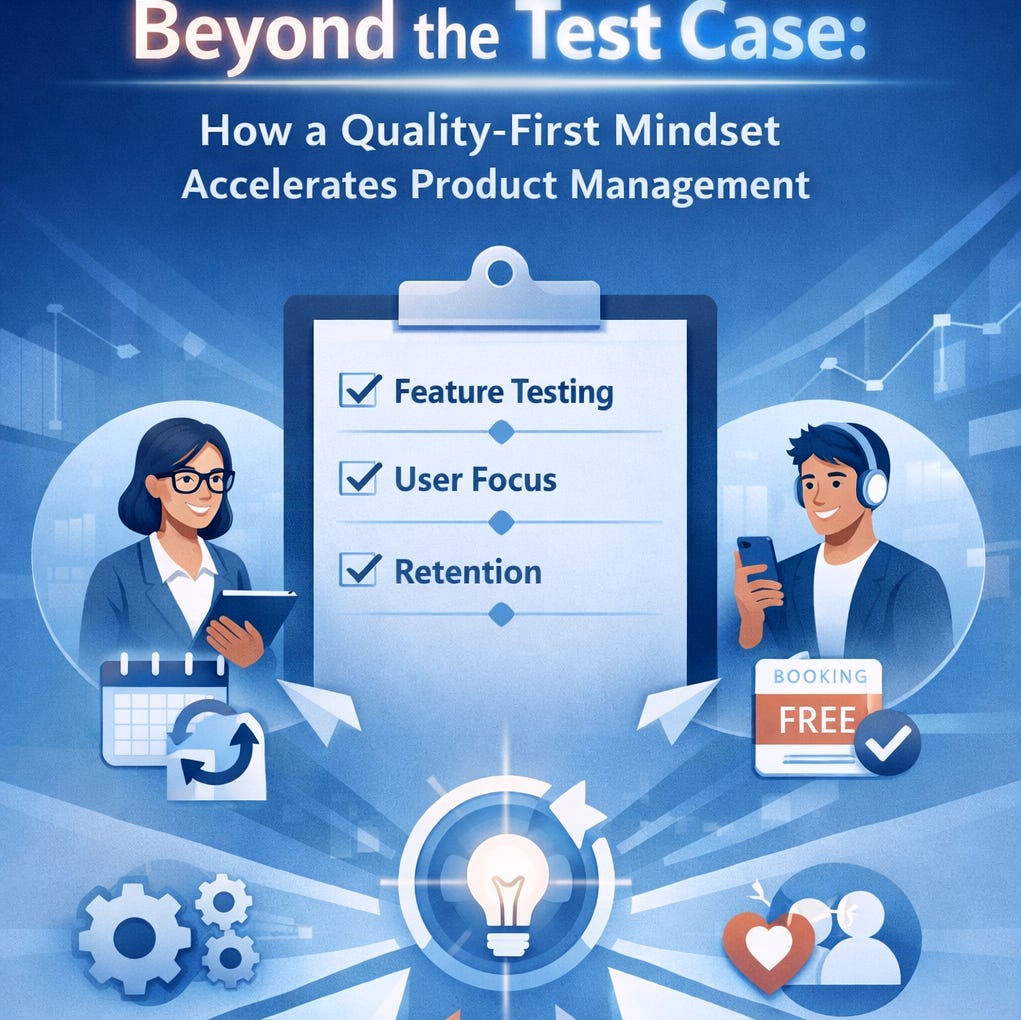
In many organisations, Quality Assurance and Product Management still sit on opposite ends of the delivery pipeline.
Product defines what to build.
QA validates what went wrong.
That separation feels logical, but it’s also where speed, clarity, and innovation quietly slow down.
The strongest products I’ve worked on weren’t built by teams that treated quality as a final checkpoint. They were built by teams that embedded a quality-first mindset into product thinking from day one.
Because quality isn’t about being bug-free.
It’s about being intentional.
Thinking Beyond the Requirement Is a Product Skill
Traditional product management focuses on requirements. QA focuses on edge cases. A quality-first PM lives in the overlap.
Instead of stopping at “Does this meet the spec?”, the question becomes:
Does this deliver the value the user actually expects?
Thinking beyond the test case means anticipating friction early, during discovery, prioritisation, and roadmap planning. It’s about asking uncomfortable questions before code is written, not after users complain.
Quality Turns Product Managers into User Advocates
After years of ensuring products “work smoothly from start to finish,” something shifts. You stop thinking like a validator and start thinking like a user.
A quality-first PM doesn’t advocate loudly; they advocate consistently. Through small decisions. Clear trade-offs. Thoughtful recommendations that align user needs with business outcomes.
When quality is prioritised from day one, teams don’t just ship features.
They ship experiences that users trust.
And trust, more than velocity, is what keeps users coming back.
Precision Is an Underrated Growth Accelerator
Quality-first product management brings a level of precision that often gets overlooked in fast-moving teams.
That precision shows up as:
Clear user stories that remove ambiguity for engineering
Stronger UAT and feedback loops that keep stakeholders aligned, even when requirements evolve
Tighter workflows that reduce back-and-forth and decision fatigue
This isn’t about perfectionism. It’s about reducing noise so teams can focus on outcomes instead of clarifications.
When clarity increases, speed follows.
Quality Is Not a Cost. It’s a Growth Lever.
In SaaS and eCommerce, growth problems often look like marketing problems, but they’re frequently quality problems in disguise.
Slow pages. Confusing flows. Unclear CTAs. Broken mental models.
A quality-first PM sees these as conversion bugs.
By pairing product thinking with analytics, CRO audits, and experimentation, quality becomes measurable.
When products perform well, trust increases.
When trust increases, conversion follows.
The Real Shift: From Catching Bugs to Driving Outcomes
The transition from “bug catcher” to “growth driver” isn’t about abandoning quality. It’s about expanding its impact.
It requires continuous learning, broader ownership, and the ability to apply a keen attention to detail to strategic decisions, not just execution.
When quality becomes the foundation of product management, teams build products that are not only reliable but also resilient, scalable, and meaningful.
And in a world obsessed with speed, that might be the most competitive advantage of all. Quality isn’t slowing you down; it’s what sets you apart.